If you’ve ever thought, “Maybe my brain just isn’t wired for this,” this course is basically here to prove you wrong. “Neuroplasticity Training: Sculpt Your Brain Like a Pro Fast” leans hard into the idea that your brain is more like a muscle than a fixed machine—and honestly, that’s what makes it interesting right out of the gate.
The course promises a lot: better focus, stronger memory, and actual habit change using science-backed techniques. Big claims—but surprisingly, it doesn’t feel like empty hype. It’s more like a mix of neuroscience, productivity hacks, and mindset training rolled into one.
Instructor Reputation
The course is led by Sancy S, and honestly, this is one of the biggest selling points of the entire program.
Unlike a lot of online instructors who mainly rely on theory or recycled self-help ideas, Sancy actually comes from a competitive memory training background. He’s not just teaching concepts—he’s lived them. Representing Singapore at international memory competitions and holding records (like memorizing massive sequences of numbers, colors, and abstract images) gives him a level of credibility that’s hard to ignore.
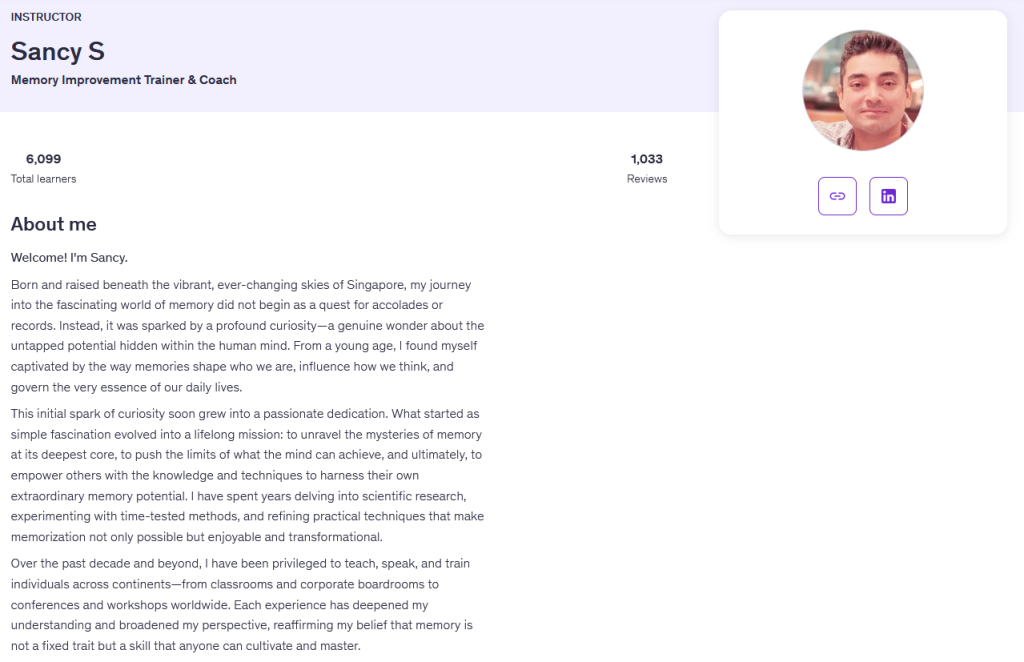
What makes this even more interesting is how he frames his achievements. Instead of presenting them as “look how talented I am,” he constantly reinforces the idea that memory is a trainable skill, not a gift. That message runs throughout the course and makes the whole experience feel more empowering rather than intimidating.
Another strong point is his experience as a trainer. He’s worked with thousands of students and professionals across different industries, which shows in how he communicates ideas. He doesn’t just dump information—he teaches. Complex topics like neuroplasticity, dopamine loops, or cognitive load are broken down into simple, digestible explanations without losing their depth.
His teaching style leans toward:
- Clear, structured explanations
- Practical examples you can relate to
- Repetition of key ideas (sometimes a bit much, but helpful for retention)
- A motivational tone without being overly “hype-y”
You can also tell he genuinely enjoys the subject. There’s a lot of passion behind how he explains memory techniques and brain training, and that energy helps keep the course engaging—especially considering how dense some of the material is.
That said, if you prefer a super fast-paced, straight-to-the-point instructor, his style might feel a bit detailed or repetitive at times. But for most people, especially beginners, that extra explanation is actually a benefit.
Overall, Sancy strikes a nice balance between scientific credibility, real-world experience, and practical teaching ability—which is exactly what you want in a course like this.
Course Structure
One thing you’ll notice pretty quickly is that “Neuroplasticity Training: Sculpt Your Brain Like a Pro Fast” is extremely comprehensive. It’s not just about memory, or focus, or habits—it’s about building an entire system for how your brain learns and operates.
Instead of feeling like a random collection of tips, the course is structured more like a step-by-step transformation process, starting from understanding your brain and moving all the way to optimizing your daily behavior.

1. Foundations of Neuroplasticity
The course starts by laying down the core idea: your brain is not fixed. You’ll learn how neural pathways are formed, how habits are wired, and why repetition and attention are so important.
This section is crucial because it shifts your mindset. Before jumping into techniques, it helps you understand why those techniques work—which makes everything else easier to apply.
2. Focus and Attention Training
Once the foundation is set, the course moves into focus—arguably one of the most practical sections.
You’ll explore:
- Why multitasking is a myth
- How “attention residue” kills productivity
- How to build a Focus Ritual to get into deep work mode
- Structured focus systems like Neuro-Focus Cycles
This part is especially useful if you struggle with distractions (which, let’s be real, most of us do). The techniques here are simple but powerful, and they’re designed to fit into everyday life.
3. Memory Systems and Learning Techniques
This is where things get really interesting.
You’ll learn a range of memory and learning strategies, including:
- Active recall (instead of passive rereading)
- Spaced repetition systems (SRS)
- Chunking information to reduce cognitive overload
- The Mind Palace technique for structured memory
- Emotional tagging to strengthen recall
What’s great here is that the course doesn’t just teach “what works”—it explains why these methods are effective based on how your brain encodes and retrieves information.
4. Habit Formation and Behavior Change
The next major section focuses on habits, and it ties everything back to neuroplasticity.
You’ll cover:
- Habit loops (cue → routine → reward)
- Identity-based habits (becoming the type of person who…)
- Habit stacking to make new behaviors stick
- Environment design to reduce friction
- Reward systems to reinforce behavior
This section stands out because it moves beyond willpower. Instead of telling you to “try harder,” it shows you how to design systems that make good habits easier and automatic.
5. Mental Performance and Flow
Here, the course dives into higher-level thinking and performance.
Topics include:
- Entering and sustaining flow state
- Switching between focused and diffuse thinking
- Creative problem-solving and lateral thinking
- Using mental models like the Feynman Technique
This part feels a bit more advanced but also more exciting. It’s less about basic productivity and more about optimizing how you think and solve problems.
6. Brain Optimization (Lifestyle Factors)
Toward the later sections, the course zooms out and looks at the bigger picture.
You’ll learn how things like:
- Sleep
- Exercise (especially its effect on BDNF)
- Nutrition
- Stress management
all play a role in how well your brain functions and adapts.
This is a nice touch because it connects cognitive performance to real-life habits—not just mental exercises.
7. Integration and Personal System Building
Finally, the course encourages you to combine everything into your own personalized system.
Instead of leaving you with isolated techniques, it pushes you to:
- Build daily routines
- Apply learning strategies consistently
- Track and refine your progress
This makes the course feel more practical and long-term, rather than something you just watch and forget.
Overall Structure
The structure is definitely one of the course’s strengths. It’s:
- Logical and progressive (each section builds on the previous one)
- Wide-ranging (covers multiple aspects of brain performance)
- Practical (focused on application, not just theory)
The only downside is the sheer volume of content. It can feel overwhelming if you try to rush through it. This is the kind of course you’re better off taking slowly, applying each concept before moving on.
But if you stick with it, the structure does a great job of guiding you from understanding your brain → training it → optimizing it → sustaining long-term change.
Content Quality
This is easily the strongest part of the course—and also the reason why it stands out from a lot of other “brain training” or productivity-style courses on Udemy.
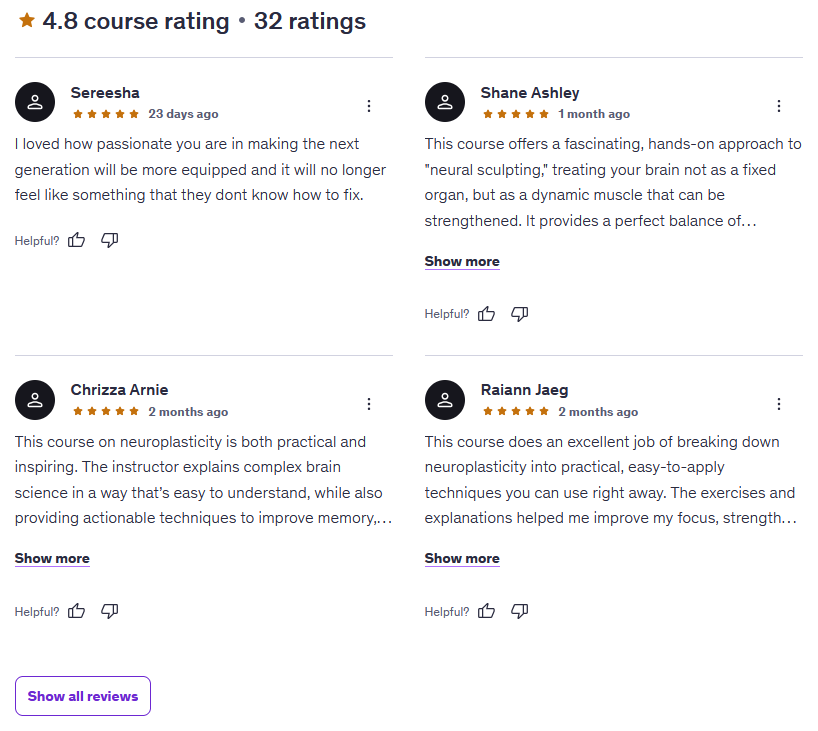
First off, the content is dense but meaningful. This isn’t filler material or recycled motivational advice. Almost every lecture introduces a concept, a framework, or a technique that ties back to how your brain actually works. You can tell there’s a strong emphasis on science-backed learning, but it’s delivered in a way that doesn’t feel overly technical or hard to follow.
Depth + Practicality Balance
One thing the course does really well is balancing depth with usability.
On one hand, you’re learning about things like:
- Neuroplasticity mechanisms
- Dopamine and reward loops
- BDNF (brain-derived neurotrophic factor)
- Attention residue and cognitive load
- Hebbian learning principles (“neurons that fire together wire together”)
On the other hand, every concept is paired with something actionable. For example:
- Learning about focus → paired with a Focus Ritual you can build
- Learning about memory → paired with active recall and spaced repetition systems
- Learning about habits → paired with habit stacking and identity-based habits
This makes the course feel less like theory and more like a playbook you can actually use daily.
Variety of Techniques
Another highlight is just how many techniques are covered. You’re not stuck with one method—you get exposed to a wide toolkit, including:
- Memory systems (Mind Palace, chunking, emotional tagging)
- Learning frameworks (Feynman Technique, active recall, spaced repetition)
- Focus strategies (deep work cycles, shutdown rituals, distraction control)
- Habit systems (environment design, reward loops, friction management)
- Creative thinking tools (diffuse mode thinking, lateral thinking)
This variety is great because different techniques will click for different people. You’re encouraged to experiment and figure out what works best for your brain rather than forcing a one-size-fits-all approach.
Real-World Application
What really elevates the content is how practical it is.
This isn’t one of those courses where you finish it and think, “Okay… but how do I actually use this?” Instead, you’ll find yourself naturally applying things like:
- Using active recall when studying
- Setting up short focus cycles during work
- Designing your environment to reduce distractions
- Attaching rewards to habits to reinforce them
A lot of the techniques are small changes, but they compound over time—which is exactly what the course emphasizes.
Repetition (Good and Bad)
One thing you’ll definitely notice is repetition. The course repeatedly reinforces key ideas like:
- “Your brain is always rewiring”
- “Focus is the save button for memory”
- “Habits shape your identity”
On the positive side, this helps with retention (which is kind of the point of the course). On the downside, some learners might feel like certain ideas are being repeated more than necessary.
Clarity and Accessibility
Despite the heavy subject matter, the explanations are very beginner-friendly. You don’t need any background in neuroscience or psychology to understand what’s going on.
Complex ideas are:
- Broken down into simple language
- Supported with relatable examples
- Reinforced through repetition and application
This makes the course accessible to a wide audience—from students to professionals to casual learners.
Minor Weaknesses
To keep things balanced, here are a few downsides:
- Information overload – There’s a lot to absorb, and it can feel overwhelming if you try to rush through
- Some overlap between sections – Certain concepts (like focus and habits) show up multiple times
- Not everything will be new – If you’ve already explored productivity or learning science, some ideas may feel familiar
Overall
The content is high-quality, practical, and grounded in real science, which is a rare combination. More importantly, it’s designed for long-term change, not just quick wins.
If you actually apply what’s taught here—even partially—you’ll likely see noticeable improvements in how you learn, focus, and build habits.
Overall Course Rating – 9/10
“Neuroplasticity Training: Sculpt Your Brain Like a Pro Fast” earns a strong 9/10 overall rating, and that score feels well-deserved given the depth, practicality, and clarity of the material.
What makes it stand out is that it doesn’t just teach you about the brain—it teaches you how to actively train and reshape it. The combination of neuroscience, memory systems, focus strategies, and habit-building frameworks creates a well-rounded learning experience that goes beyond typical self-improvement courses.

What it does really well
- Bridges science and action – You’re not left with abstract ideas; you get concrete systems to apply
- Covers multiple areas of improvement – Memory, focus, habits, and mental performance are all addressed
- Builds a long-term mindset – The course emphasizes sustainable change rather than quick fixes
- Instructor credibility – The background of Sancy S adds real weight to the teachings
Where it falls short
- The sheer amount of content can feel overwhelming
- Some repetition might not appeal to advanced learners
- It requires effort—this is not a passive “watch and improve” course
Who this course is best for
- Students who want to study smarter and retain more
- Professionals struggling with focus and productivity
- Anyone trying to build better habits and break bad ones
- Lifelong learners interested in optimizing their brain
If you’re looking for a course that gives you practical tools backed by real science, this is one of the better options out there.
It’s not the kind of course you casually watch and forget—it’s the kind you apply, revisit, and build on over time. And that’s exactly why it’s valuable.
Bottom line: if you’re willing to put in a bit of effort, this course can genuinely change how you think, learn, and work.